

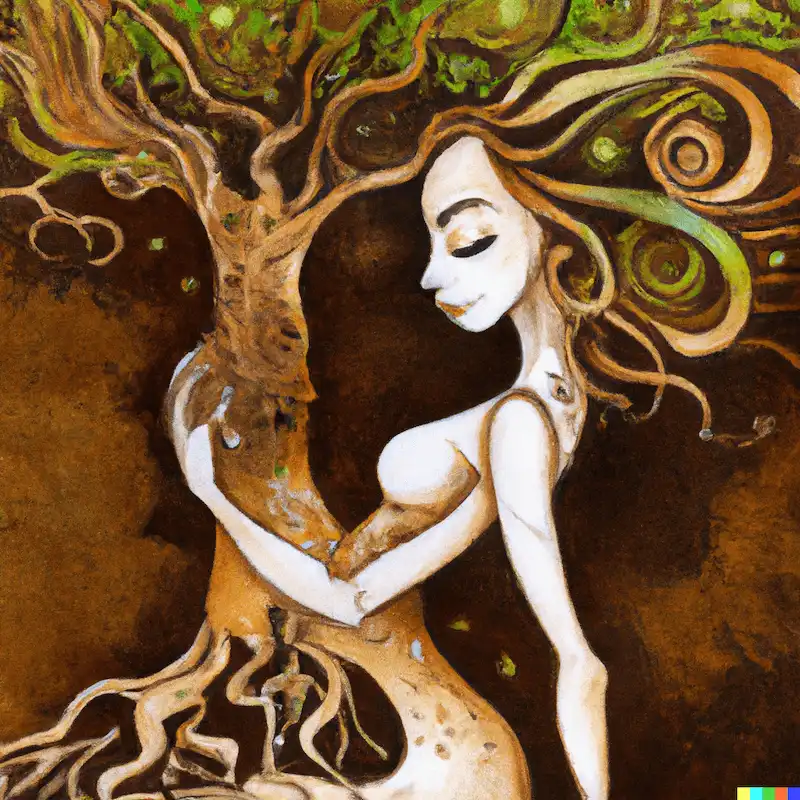
The Root Women
For many Indigenous communities, the long journey toward revitalizing legal traditions and governance structures involves restoring women’s roles within their communities.
Before the arrival of Europeans, there was a vast array of governance models that helped maintain social balance. In many cases, social structures relied on the strength of female power. Some societies, particularly those with a more sedentary lifestyle, had developed matrilineal models centered on the transmission of the clan through the mother and the organization of the nuclear family around her.
Other Indigenous societies emphasized the complementary nature of gender roles and the collaborative nature of relationships between men and women. This was the case, for example, in most Algonquian nations, where women held central roles that were essential to the organization and cohesion of groups as they moved across the territory.
Women’s power was evident in travel planning, family organization, and participation in political decision-making. Moreover, oral traditions are replete with examples of the importance of women in knowledge related to the land, the sacred, and traditional medicine.
In some creation stories, it was even through the actions and breath of a woman that the Earth we walk upon was created.
However, the first European settlers who sought to exploit the riches of traditional territories were oblivious to the social organization of Indigenous peoples, which was based on the complementary nature of masculine and feminine forces. This is evident, among other things, in the writings of early travelers, missionaries, and explorers, in which women’s roles are downplayed, objectified, or outright ignored.
Subsequently, government authorities waged a campaign against Indigenous womanhood through official measures. For decades, women were barred from leading their communities and even from voting. Through the Indian Act, Canada sought to control whom they could marry and have children with. Ultimately, through the imposition of mandatory attendance at residential schools, mothers, aunts, sisters, and grandmothers no longer had children with whom to fulfill these roles.
The problem is that this erasure of women’s importance, combined with assimilation policies that targeted them directly, contributed to a dramatic destabilization of Indigenous communities. Worse still, colonial policies and the imposition of Western belief systems and values have helped create conditions conducive to the development of stereotypical views and the normalization of violence against Indigenous women and girls. The tangible effects of this deplorable situation are reflected not only in statistics on domestic violence and the all-too-frequent cases of disappearances and femicide, but also in the overrepresentation of Indigenous women in the prison system.
Little by little, as minds become decolonized, women are reclaiming their rightful place. Mothers are once again becoming clan mothers, aunts are resuming their protective roles, and grandmothers can once again rock their grandchildren to sleep and watch them grow up.
In addition, more and more inspiring women are taking on executive or political leadership roles as part of an effort to reclaim this power that has been taken from them.
Since the 1970s, many Indigenous women have protested, marched, taken their causes to court, and shattered glass ceilings. They are paving the way through acts of healing and serving as a bridge between a decolonized future and a wounded past.
Through their actions, our nations are finally putting down roots again and beginning to draw strength from the richness of our lands and our ancient cultures.